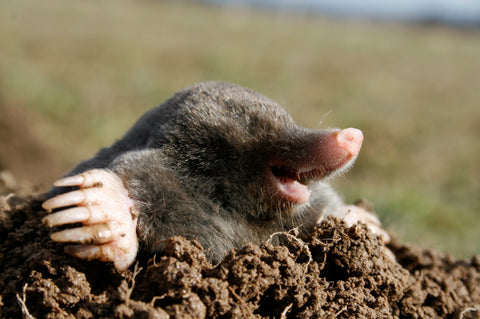
The best way to determine what type of pest you have is by the damage you see.
Moles:
If you have a mole, you will see mounds of dirt and/or surface tunnels:
Not all moles will have both surface tunnels and dirt mounds. If you see one or the other (or both), you have a mole.
Pocket Gophers:
Damage done by pocket gophers is similar to moles, but there is a major difference.
If the damage seems to be that of a pocket gopher, we recommend viewing the University of California's website on this topic.
Ground Squirrels:
The key identifier for these rodents is an exposed tunnel entrance with discarded dirt surrounding the entrance of the tunnel. You can see right into a ground squirrel burrow, unlike that of moles or pocket gophers. Read more about ground squirrels at the University of California website on this topic.
Voles:
While voles can create damage to trees, shrubs, bulbs and perennials consuming roots, and eating bark from the base of small trees; they typically “piggy back” on the damage done by moles. Voles (often incorrectly referred to as “meadow mice”) tend to travel in mole tunnels and often are the cause of damage to roots, bulbs, and tubers within.
If you suspect that you have a pest other than moles, we do NOT recommend using our product. It is not intended for use with any other pest.
Moles can be trapped in almost any season and most weather conditions. There is no specific time when they are easier to catch. Moles dig in the same way at any time of the year, but they do tend to be more active during the spring, summer and fall. When moles are more active, they use their runs more frequently and thus have a greater exposure to a set trap.
Moles create tunnels for two purposes, traveling and feeding. Traveling tunnels are pathways between feeding areas and the den. Feeding areas are usually marked by clusters of hills and shallow tunnels. Their purpose is allow the mole to hunt for its main diet, worms. The mounds or "mole hills" are excess dirt that has been mined away by the mole to create these tunnels.
No, the only indication the size of the pile will give is whether the soil is easy for moles to dig through or not. If the soil is easy to dig through, you will probably have smaller mole hills, but mole hills will be more frequent. If the soil is difficult, the mole hills will be larger and less frequent.
Moles often scrape away dirt from the root system of plants in search of grubs and worms. In doing this, moles scrape away the plants' source of nourishment and the plant dies. Many times, voles will also travel in mole tunnels and will eat roots and bulbs along the way.
Moles are almost entirely carnivorous; however, it is true that moles can indirectly kill plants. They do this in two ways:
The tunnels created by moles will often be used by other small animals. Voles, in particular, will travel in these tunnels and eat away at roots and tubers. A good location for grubs and worms is among the roots of a hedge, flower, or other type of plant. The mole will scrape the dirt away from the roots in search of food, thereby removing the plants’ source of nourishment.
Moles generally do not get along with one another. In fact, they will often fight to the death if another mole infringes upon their territory (obviously this is not true during mating season).
We have had mixed experiences on this matter. In many cases, we have found one mole doing a significant amount of damage. Upon trapping it, the activity dies down and there is no more activity. In other situations, we have caught up to 12 moles in a 10-foot square area within 3 weeks. Having researched this matter further, we agree with the observations made by Donald and Lillian Stokes in their book, Animal Tracking and Behavior 1986:
"Moles are believed to remain solitary as adults and avoid contact with other moles. However, there are at least two exceptions. One occurs in the spring, when the males start to move around and leave their range in search of females. They may move about for several weeks, even after all the females in an area have mated. The other exception is that occasionally some tunnels are used by several moles; these tunnels are, in a sense, like highways. This communal use suggests that the social system of moles is more complex than we think."
This misconception is usually the result of people looking out their window in the morning and seeing fresh mole hills. In fact, moles are not necessarily more or less active at any time during the day or night. Current research suggests that moles sleep and work in 4-hour shifts. They are more active during quiet periods, such as early morning or late in the evening. When they feel vibrations in the ground, as created from people or pets walking, they will be more likely to cease their digging.
Moles have extremely tiny eyes that are basically a thin membrane behind their snout. These "eyes" allow them only to sense light and little else.
Most lab and field tests will show that while moles do have a voracious appetite, they only eat up to 70 – 100% of their body weight each day.
Yes, on occasion, a crafty cat or dog can catch a surfaced mole. It is very rare and typically happens to only the mole pups.
Most mole problems consist of one or two moles doing a considerable amount of damage. A good indication of how many moles you may have is to clear all the hills away with a rake. You can then determine how many areas are active concurrently by observing where the new mole hills are being created. If you have two different areas of fresh mole activity in one night, there is a possibility you have more than one mole. If you have only one area active at a time, you may have only one mole. There is no concrete way of determining exactly how many moles there are until moles are trapped and there is no more activity.
Moles will often seek new territory during the spring and early summer when the baby moles (“pups”) are searching for their own territory. As well, heavy machinery and extensive excavation (as is often the case with heavy construction), can displace moles and cause them to find a new domain.
Moles rarely surface, and almost never travel above ground. It is then highly unusual for a mole to scurry around in a house since such a journey would be particularly perilous for an animal that is not equipped to travel on open flat surfaces. The exception would be for those homeowners with a shallow or no house foundation. In such situations, moles can be heard scratching underneath the shallow floor as they navigate in their tunnels.


The most defining physical characteristic of the mole is its forepaws. They are usually about the size of a nickel and appear disproportionately large compared to the rest of the body. All species of moles have sharp nails and, except for the American Shrew-mole, webbed paws. This equipment makes them exceptionally efficient at digging their trademark tunnels.
When tunneling, the mole will scrape away dirt with its front paws. In a swimming-like motion, it brushes the dirt within reach of the hind legs. The mole will then "kick" away the dirt to keep its working area clean. After the mole has excavated a sufficient amount of dirt, it will turn around in the tunnel (some studies report observing moles doing a somersault) and push the dirt up to the surface, creating a mole hill.
The coat of a mole is so incredibly dense that it keeps out water and dirt. Because their fur points straight up, moles can move forward or backward within their tunnels without rubbing their fur the wrong way and trapping soil in their coats. In addition, mole hair does not taper down at the end like that of a human. It is widest in the middle of the strand and thinnest on either end. This protective feature also contributes to keeping the coat free of dirt and water.
In less politically correct times, mole skin was highly prized for its softness and durability. The coats were used for anything from vests to ballerina slippers.
With the exception of the Star-nosed Mole, snouts are long and pointed, somewhat resembling that of a pig. They are the most sensitive part of the mole and provide it with most of its sensory information. Some biologists even believe that certain moles have very small electrical and magnetic sensors in their nose which enable them to navigate in their dark little world.
The eyes of a mole are very tiny and, in the opinion of most experts, serve only a limited function. They are comprised of a thin membrane around the snout which enables them to sense light and little else. There is no evidence to suggest moles use them to locate their prey or to navigate.
Tails vary depending on the breed of mole. For Eastern, Coast, and Townsend moles, tails are usually short and almost hairless. Star-nosed, Broad-footed, American Shrew and Hairy-tailed moles have tails that are typically longer and covered with hair. Tails serve to provide additional sensory input, but do not provide substantial utility to the mole.
Moles are very robust animals and can survive in rather adverse conditions. Most often, however, they tend to dig up prized lawns, golf courses, and carefully-tended gardens. The reason lawn and garden moles seem to dig more frequently in the most fertile areas is that such conditions usually indicate a plentiful supply of its main food source – worms. Good soil means lots of worms, and moles are sure to follow. The primary variables that determine good soil (and therefore mole activity) are moisture, warmth, vegetation, and soil acidity.
Earthworms are not native to North America; they were introduced from Europe. North American moles ate insect larvae and other invertebrates before worms were available. When the plentiful supply of worms became available, the North American mole population exploded rapidly.
While moles are almost entirely carnivorous, soft vegetation such as seeds and soft root systems can comprise a small portion of the diet. The aquatic Star-nosed mole, however, has been known to eat small fish.
Moles are not simply nomadic creatures that eat whatever they can find. Similar to chipmunks, European moles often "store" worms. They do this by biting the worm on the area that controls motor activity. Once neutralized, the worms are dragged to a den or storehouse where up to 20 – 30 worms may be found at any one time.
Most species prefer loose soil that is moderately moist as found in a well-watered lawn or garden. Dry soil does not provide a good food supply to the mole since worms typically prefer moisture. Wet and clumpy soil is also not preferable since digging and tunneling is especially difficult for the mole under these conditions. Again, the exception is the Star-nosed mole mole, which can be normally found in wet soils, in marshes, and along streams, so it rarely causes problems in yards and turf.
Moles prefer moderate temperatures and will typically go deeper into the soil during the hot summer and cold winter months. They are more active during the late spring, early summer, and fall.
While not an absolute necessity, well-vegetated areas tend to be likely areas for mole territories. Quite often these soils are relatively loose and heavily endowed with a good food supply.
Soils with a fairly low acidity are more favorable to moles. Low acidity is typically indicated by areas with a high level of vegetation. High acidity can be caused by rainwater runoff or decomposing organic matter such as the fallen leaves of deciduous trees.
Well-kept lawns and gardens provide an excellent habitat for moles. So, if you do have a mole in your yard, try to see the bright side and see it as a compliment to your gardening skills!
The destruction most people associate with moles is the volcano-like mounds of dirt that are pushed to the surface. Moles will use their powerful front paws to claw at the dirt and pack it on all sides to create a tunnel. They will then turn around in their tunnel and push the dirt to the surface. The excavated dirt creates a pile that can get larger than 2 feet in diameter (although most are ½" – ¾" in diameter). These unsightly piles will then settle to create bare spots on grass.
Another common calling card of lawn moles or garden moles is the "surface tunneling" that appears as a long series of "vein-like" upward cracks in soft soil such as newly-laid sod or gardens.
Many people with mole problems complain of walking across their lawn only to notice their feet sinking on what feels like spongy grass. Many times this sinking feeling is caused by the weight of the person collapsing a shallow mole tunnel.
Moles can undermine concrete slabs, driveways, pools, and even shallow foundations. These situations can be either irreparable or extremely expensive to fix. Most insurance policies will not cover this type of damage, so you now have a very good reason to get rid of your moles quickly with effective mole control.
Of this type of mole damage, the worst we have ever seen was a gentleman whose pool had been undermined from the bottom. His pool tiles consequently cracked from the weight of the water and his pool had to be drained, unearthed, resealed, and re-filled. The total charges went up to almost $3,000.
The mole damage you don’t see is usually the most destructive. When you see several piles on a lawn, you should realize that dirt is coming from somewhere and often times it is from deep tunnels in the ground. Moles are extremely efficient diggers and can excavate 12 – 15 feet of tunnel per hour. These tunnels will probably not be noticed at first, but people who have had moles for several years complain of their entire soil level sinking, or they notice large sunken areas in the grass. This type of damage can be impossible to simply "patch up" and often times will require tilling the entire lawn and replanting it.
One gentleman we worked for had the foundation of his patio supports undermined by deep tunneling. His entire patio sunk and required a backhoe to repair the damage. On many other occasions, we have seen several people who had to bring in several dump truck loads of soil to replace the undermined areas and reseed the entire lawn.
Mole Hills: Scoop the dirt with a shovel or your hands. Spread the dirt evenly around the surrounding soil and clear any excess with a rake. Don’t simply stamp down the mole hill or a large bare patch will be left in the grass.
Shallow Tunnels: Simply stepping on the raised tunnels will pack them down sufficiently.
Deeper Tunnels: We recommend renting a gas-powered stamper as is used in packing down newly-seeded lawns. Only use this in extreme circumstances as much of the damage will settle on its own.
Moles are generally solitary animals. One exception to this rule is during mating season which usually runs from February to April. The usually reclusive males will go in search of a receptive female by emitting high-pitched squeals and tunneling through foreign areas.
Gestation usually lasts between 4 – 6 weeks. Depending on the species, mole litters usually range from 2 – 6 baby moles (or pups). All species of moles breed only once per year.
Pups do not stay under the mother’s care for very long. After only a few months of being nourished by their mother’s rich milk, the pups will be forced to strike out on their own. Not having the strength of an adult, the pups will often travel in loose soil or even above ground in the treacherous search of their own territory.
During these months (usually late spring and early summer), it is a very common for cats, owls, and other predators to catch baby moles (many of our customers note that their cats have the unfortunate habit of presenting dead moles, rats, and birds on the doorstep of the house as trophies worthy of praise). Another common sight is for young moles to appear drowned in swimming pools.
Moles are sexually mature about 10 months after birth and will usually live for 3 – 5 years, depending on their health and surroundings.

